
KYB for a Moroccan SARL: the document checklist
KYB Morocco documents for a SARL: the documents banks usually ask for, what the law and Bank Al-Maghrib texts say, and how beneficial owners are identified.
The Sahl Team · · 12 min read
In short
KYB means checking that a business exists, who runs it and who owns it. For a Moroccan SARL, banks usually ask for the commercial register extract, the statutes, proof of who the manager is, tax and social security documents, and proof of the beneficial owners.
Bank Al-Maghrib defines a beneficial owner as a natural person who holds more than 25% of the capital or votes, or who controls the company by other means.
Banks usually ask for the last 3 months of documents, sometimes 6. This is common practice, not law.
What is KYB, and who asks for it in Morocco?
KYB stands for know your business. It is the company version of KYC. Before a bank opens an account, a lender grants credit or a platform pays out, it must know the company, the people who can act for it and the people who ultimately own it.
The rule comes from anti-money-laundering law. In Law 43-05 as amended by Law 12-18, article 4 requires reporting entities to determine and verify the identity of the beneficial owner and to understand the ownership structure of legal persons. It forbids opening or continuing a relationship if the client or the beneficial owner cannot be identified. Under article 7, identity documents are kept for ten years from the end of the relationship, and transaction documents for ten years from the transaction. The central bank is the control authority for banks, as Bank Al-Maghrib's own page states.
The practical rules for banks sit in circular 5/W/2017, amended by circular 3/W/2019, and in directive 2/W/2019 on identifying clients and beneficial owners.
Those texts apply to credit institutions.
What does a SARL look like in law?
You need this to read the checklist, because each document proves one of these facts. The source is Law 5-96 (Dahir 1-97-49 of 13 February 1997), in the consolidated version of 19 August 2021.
- Form and liability. A SARL is formed by one or more people who bear losses only up to their contributions (article 44). With one partner it is a SARL d'associé unique. Banks and insurers cannot use this form.
- Capital. The partners set the capital freely in the statutes (article 46, as replaced by Law 24-10 of 2011). There is no legal minimum today.
- Partners. No more than 50 (article 47). Above that, the company has two years to convert into a joint-stock company or it is dissolved.
- Statutes. They must be dated and state, on pain of nullity, the partners, the object, the name, the registered office, the capital, each partner's contribution, how the parts are shared and fully paid, the duration, who can bind the company and the signatures of all partners (article 50).
- Contributions. Parts must be fully subscribed and paid. Cash contributions go into a blocked bank account within 8 days, released against a registry attestation (articles 51 and 52).
- Manager. The company is managed by one or more natural persons, who may be non-partners. If the statutes are silent, the term is three years (article 62). Toward third parties the manager has the widest powers, and statute limits cannot be used against them (article 63). The partners can remove the manager with three quarters of the parts (article 69).
- Accounts. Partners approve the accounts within six months of year end (article 70). An auditor is mandatory above 50 million dirhams of turnover excluding tax (article 80).
- Existence. A company has legal personality only from its registration in the commercial register (article 2). Under the Commercial Code (Law 15-95), legal persons must register within three months of formation (article 75). Statutes are filed within 30 days and a notice is published within 30 days after registration (Law 5-96, articles 95 and 96).
Which documents does a Moroccan SARL need for KYB?
Start with what the central bank names, then add what each counterparty asks for.
Circular 5/W/2017, as amended, requires a client file for every company before an account is opened or a relationship starts. The file records identification elements that depend on the legal form. The documents it expects include the constitutive act (article 15), and article 20 also refers to statutes and meeting minutes. Directive 2/W/2019 adds the head office address, corporate purpose, sector of activity and updated financial situation, such as annual accounts or the tax return package.
The checklist below separates what a text names from what banks usually ask for. "Central bank" and "Law" mean the text named in the row. "Banks usually ask for" means practice: I did not read a primary legal text that lists the document, so it is not stated as a legal requirement.
Banks usually ask for the last 3 months of documents, sometimes 6. This is common practice, not law, and each institution sets its own limit.
| Document | What it proves | Basis | Where to get it |
|---|---|---|---|
| Commercial register extract (RC) | Company exists, legal form, registration number, manager and partners as registered | Banks usually ask for it. Directive 2/W/2019, art. 11, mentions it to verify a beneficial owner. Law 15-95, art. 29, gives anyone the right to an extract | OMPIC or the court registry (greffe) |
| Statutes, certified copy | Object, capital, partners, who can bind the company | Central bank (constitutive act, art. 15; art. 20) and Law 5-96, art. 50 | Company; filed at the registry |
| Minutes naming or changing the manager | Who can legally act now | Central bank (meeting minutes, art. 20) | Company; filed at the registry |
| ID of each manager and beneficial owner | The real people behind the company | Central bank (identity of persons operating the account and of beneficial owners); Law 43-05, art. 4 | The person |
| Beneficial owner declaration, or register extract | Who owns more than 25% or controls | Law 43-05, art. 4 and art. 13.3; directive art. 11 | Company; the OMPIC register at rbe.ompic.ma |
| Head office address proof | Where the company operates | Central bank (directive art. 21) | Lease, utility bill or title |
| Annual accounts or tax return package | Financial position and activity level | Central bank (updated financial situation, art. 21) | Company |
| ICE (common company identifier) | Company identifier | Banks usually ask for it | RC extract and tax documents |
| Tax identifier (IF) | Registered with the tax office | Banks usually ask for it | Tax office (DGI) |
| Tax compliance attestation | Taxes declared and paid | Banks usually ask for it | DGI, through its SIMPL attestation service |
| CNSS affiliation and statement | Registered as an employer | Banks usually ask for it | CNSS |
| Taxe professionnelle registration | Registered for local business tax | Banks usually ask for it. Law 47-06, arts. 5, 13 and 14, set the tax | Municipal tax service |
| Bank certificate or RIB | The account the funds will use | Banks usually ask for it | The company's bank |
| Documents issued abroad, certified | Foreign shareholders or parent | Central bank (circular 3/W/2019) | Competent authority abroad |
Sources: Bank Al-Maghrib circular 3/W/2019 and directive 2/W/2019; Law 43-05; Law 5-96; Law 15-95; Law 47-06. Links at the end.
Law 47-06 on local taxes replaced the old patente with the taxe professionnelle (article 176). It says that every person who carries on a professional activity in Morocco is liable (article 5), that taxable elements are declared by 31 January of the year after the activity starts (article 13), and that the tax identification number must be displayed in each establishment (article 14). The word "patente" is still used in daily speech, but the statute does not use it.
Documents issued abroad need extra care. If the original is not shown, photocopies of statutes, minutes and similar documents made abroad must be certified by the competent authorities, subject to ratified international conventions, according to circular 3/W/2019.
Who counts as a beneficial owner?
A beneficial owner is always a natural person. Law 43-05 defines it as the person who ultimately owns or controls the client. Directive 2/W/2019, article 11, gives two tests.
The first is ownership: a person who holds, directly or indirectly, more than 25% of the capital or voting rights. The second is control: a person who controls the management bodies or the meeting of partners by other means, for example through a shareholders' pact. If neither test finds anyone, the legal representatives are treated as the beneficial owners.
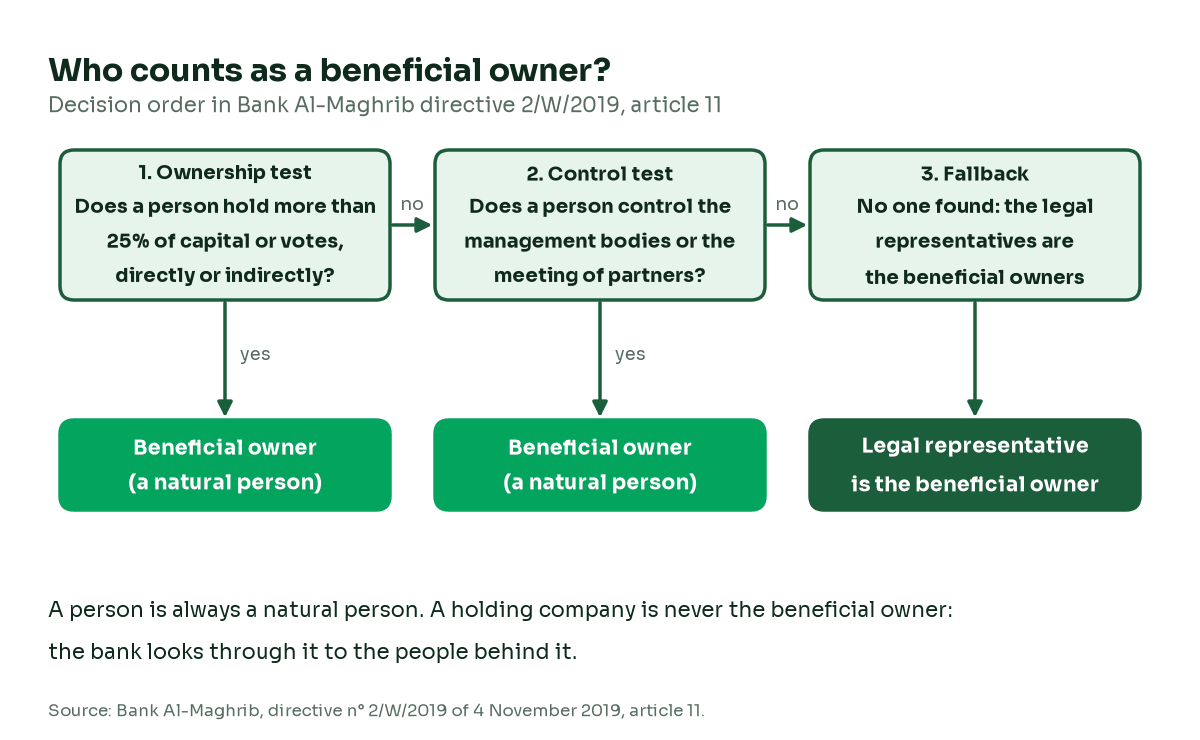
The tests count indirect holdings, so a holding company in the structure does not end the analysis: the bank looks through it to the natural persons who own it.
The beneficial owners register
Morocco keeps a public register of beneficial owners. Its legal basis is article 13.3 of Law 43-05 as amended by Law 12-18: a public register of the beneficial owners of legal persons formed in Morocco, kept under the finance ministry, with management that can be entrusted to a public body. OMPIC runs it at rbe.ompic.ma.
Under the directive, a bank can verify the identity of a beneficial owner from the commercial register extract, provided it shows full name, date of birth and place of birth, unless the risk is high or there is any suspicion.
How do you assemble a KYB file, step by step?
- Ask for the company's legal identity. Banks usually start with the RC extract and the ICE. Check name, legal form and registration number.
- Read the statutes. Check the object, the capital and the clause on who can bind the company.
- Match the manager. The manager named in the minutes must match the RC extract and the statutes. If the manager changed, ask for the minutes and the updated extract.
- Trace the ownership. Build the chain from the partners to natural persons and apply the two tests.
- Verify each person. Valid ID for managers and beneficial owners. Screen them against sanctions and politically exposed person lists as your policy requires.
- Check tax and social security status. Banks usually ask for the tax attestation and the CNSS statement.
- Understand the business. Compare the stated object with what the company actually does, and ask for financials.
- Record and diary. Keep what you checked, when, and by whom, for at least the ten-year retention period in Law 43-05 article 7, and set a date to review.
Manual re-keying is where many errors start. One bank-group case, which is not about KYB documents, gives a sense of scale.
40%
What else do banks look at besides documents?
They look at the business as well as the papers.
Directive 2/W/2019, article 21, says that for companies the bank gathers, from reliable and independent sources, the head office address, the corporate purpose, the sector and the up-to-date financial situation. Where risk calls for it, it also looks at main suppliers or customers and the countries where the company has operated.
How do you check that the documents are real and current?
Three checks:
- Date. Banks usually ask for the last 3 months of documents, sometimes 6. This is common practice, not law.
- Consistency. The company name, legal form, address, manager and partners must match across the extract, the statutes and the minutes.
- Source. Where the issuer offers an online check, use it. The tax administration has a verification page for its attestations.
About Sahl
At Sahl we build verification and data tools for lenders and banks. The platform page explains what we offer, the developers page covers integration, and the security page describes how we protect data. Business onboarding connects to the rest of the credit process: see thin-file borrowers and open banking in Morocco.
This article is general information, not legal advice.
What to do next
Confirm fees and procedures on the OMPIC and tax administration sites.
Glossary
- KYB: know your business, identification and verification of a company.
- KYC: know your customer, the same for a person.
- SARL: société à responsabilité limitée, a limited liability company.
- Statutes (statuts): the company's constitutive document.
- Gérant: the manager, a natural person in a SARL.
- RC: registre de commerce, the commercial register, kept by OMPIC and court registries.
- OMPIC: Office Marocain de la Propriété Industrielle et Commerciale.
- ICE: identifiant commun de l'entreprise, common company identifier.
- IF: identifiant fiscal, the tax identifier.
- CNSS: Caisse Nationale de Sécurité Sociale.
- Taxe professionnelle: the local business tax that replaced the patente.
- RBE: registre des bénéficiaires effectifs, the beneficial owners register.
- Beneficial owner: the natural person who ultimately owns or controls a company.
- DGI: Direction Générale des Impôts, the tax administration.
- RIB: relevé d'identité bancaire, the bank account details.
FAQ
What documents are needed for KYB on a Moroccan SARL?
The central bank texts refer to the constitutive act, statutes, meeting minutes, identity documents, the beneficial owner and the head office address. Banks usually ask for the commercial register extract, the ICE, the tax identifier, a tax compliance attestation, CNSS affiliation, taxe professionnelle registration and a bank certificate. This is practice, not law.
What is the difference between KYC and KYB?
KYC identifies a person. KYB identifies a company, its legal form, the people who can act for it and the people who own or control it. KYB includes KYC on those people.
Who is a beneficial owner of a SARL in Morocco?
A natural person who holds, directly or indirectly, more than 25% of the capital or voting rights, or who controls the company by other means. If no one qualifies, the legal representatives are treated as beneficial owners, under Bank Al-Maghrib directive 2/W/2019, article 11.
Is there a public register of beneficial owners in Morocco?
Yes. Article 13.3 of Law 43-05, as amended by Law 12-18, creates it, and OMPIC runs it at rbe.ompic.ma.
How old can KYB documents be?
Banks usually ask for the last 3 months of documents, sometimes 6. This is common practice, not law, and each bank sets its own rule.
Is there a minimum capital for a SARL in Morocco?
No. Article 46 of Law 5-96, as replaced by Law 24-10, says the partners fix the capital freely in the statutes.
Do foreign shareholders change the KYB file?
Circular 3/W/2019 says photocopies of statutes, minutes and similar documents made abroad must be certified by the competent authorities, subject to ratified international conventions. The beneficial owner tests count indirect holdings.
What is the difference between patente and taxe professionnelle?
The taxe professionnelle replaced the old patente under Law 47-06, which repealed the patente in article 176. People still say patente in daily speech.
Sources
All links were opened on 7 October 2026 unless noted.
Laws and regulations, primary
- Law 43-05 on money laundering, consolidated with Law 12-18: articles 1, 4, 7 and 13.3.
- Bank Al-Maghrib circular 3/W/2019 (amending circular 5/W/2017, articles 15 and 46) and directive 2/W/2019, articles 9 to 12 and 21.
- Bank Al-Maghrib, role in the AML framework.
- Law 5-96, consolidated version of 19 August 2021: articles 2, 44 to 47, 50 to 52, 62, 63, 69, 70, 80, 95 and 96.
- Law 15-95, Commercial Code, consolidated version of 19 December 2019: articles 29 and 75.
- Law 47-06 on local taxation (Dahir 1-07-195, Bulletin Officiel n° 5584 of 6 December 2007), articles 5, 13, 14 and 176.
Administrations, primary
- OMPIC, beneficial owners register.
- DGI, SIMPL attestation service and attestation verification page.
Practice, not law
- Items described as "banks usually ask for" (ICE, IF, CNSS, tax attestation, bank certificate, document age) rest on practice, not on a primary legal text.
- KYB
- KYC
- SARL
- beneficial owners
- Bank Al-Maghrib
- compliance