
Thin-file borrowers in Morocco: who they are and what the law says
Thin file credit scoring in Morocco: what public data shows about young adults, women, informal workers and small firms, and what Law 01-22 on credit bureaus says.
The Sahl Team · · 15 min read
Updated
In short
A thin-file borrower has little or no repayment history in a credit bureau, so a lender has nothing to score.
In 2024, 30.21% of people aged 15 to 24 had an account, and 34.68% of women. In 2023, 22.0% of surveyed firms had a bank loan.
Law 01-22 on credit bureaus widens the data bureaus can hold, but it takes effect only when Bank Al-Maghrib publishes its implementing texts, and I found no sign that this has happened.
What is a thin-file borrower?
A thin-file borrower is a person or business that a credit bureau knows little or nothing about. There is no loan history, no card history, or only one or two items.
Who are the thin-file borrowers in Morocco?
Public data covers four groups. Nobody publishes a count of thin files in Morocco, so none of these numbers is one.
Young adults. The World Bank's Global Findex 2025 shows that 30.21% of Moroccans aged 15 to 24 had an account in 2024, down from 35.90% in 2021. For all adults the figure was 44.39% in 2024 and 44.37% in 2021 (World Bank data).
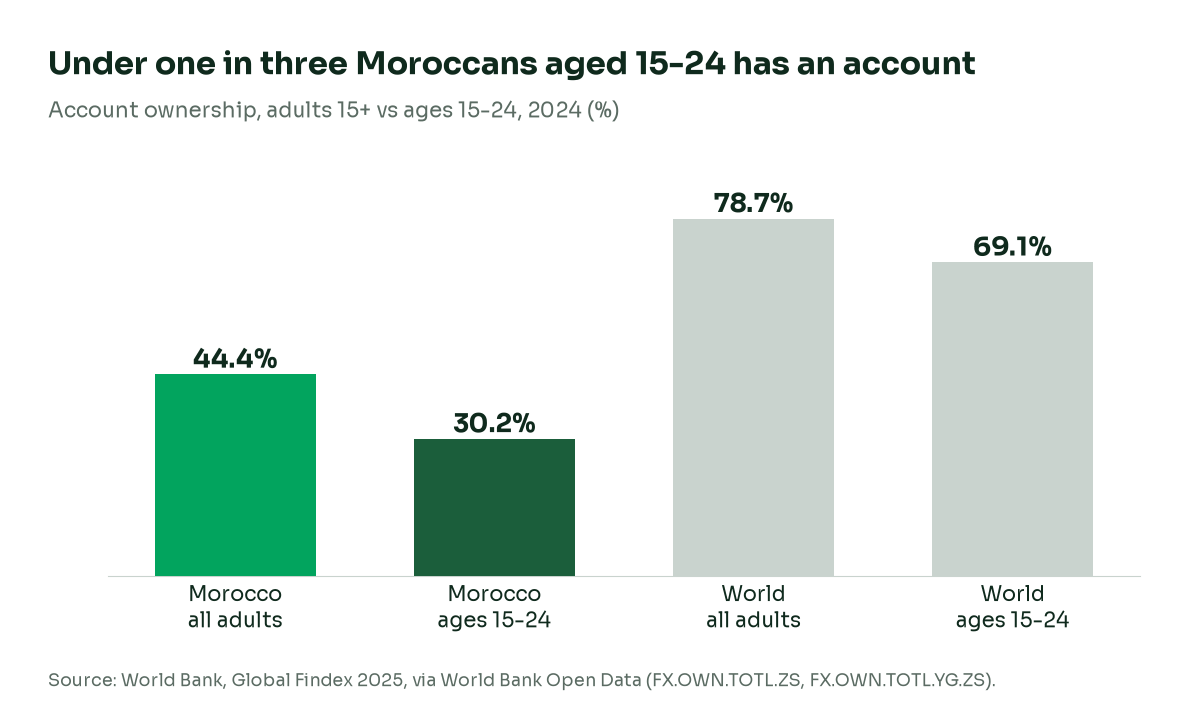
Women. The same survey puts account ownership at 34.68% for Moroccan women in 2024, against 54.63% for men (women, men).
Workers outside formal contracts. The High Commission for Planning (HCP) informal sector survey 2023/2024 counts 2.53 million jobs in the informal sector, 33.1% of non-agricultural employment in 2023. Its 2025 employment results show that 54% of wage earners have a contract: 28.2% open-ended, 14.7% fixed-term and 11% verbal. Only 31.6% of employed people have medical coverage linked to their job.
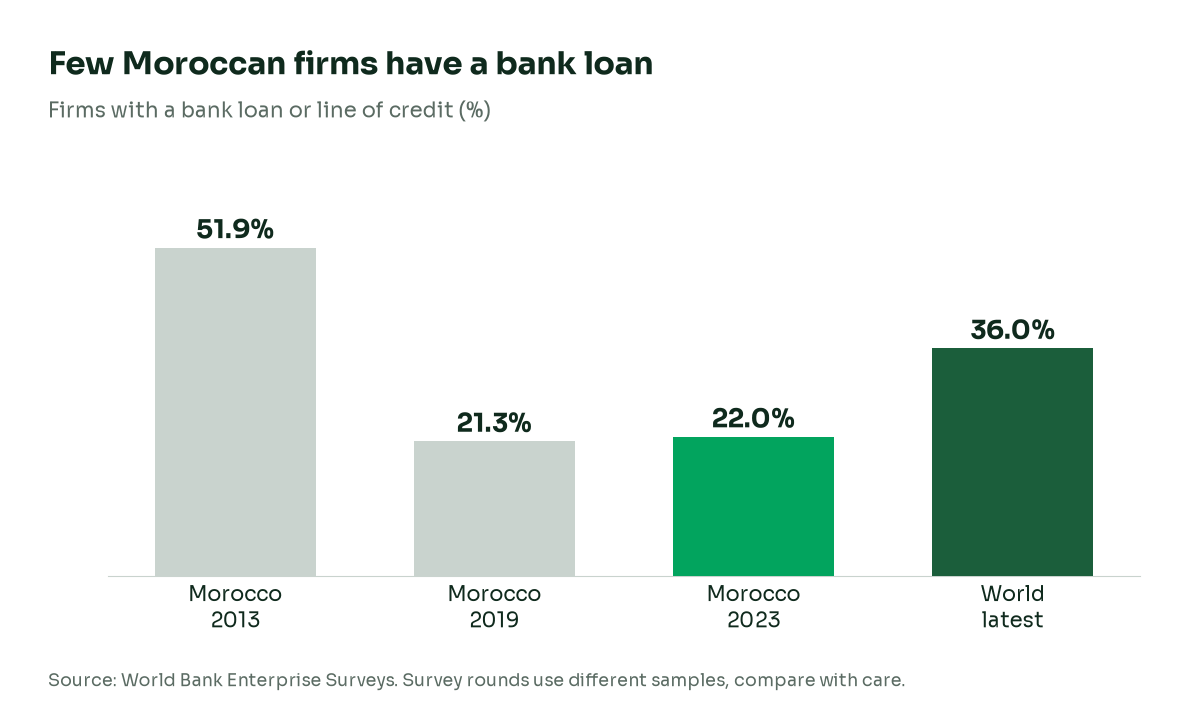
Small businesses. The World Bank Enterprise Surveys show 22.0% of surveyed Moroccan firms with a bank loan or line of credit in 2023, against 21.3% in 2019 and 51.9% in 2013 (World Bank data API). The samples differ from round to round.
There is a nuance. In the 2023 survey microdata (598 firms, unweighted counts, so indicative only), 23.7% of firms called access to finance a major obstacle and 3.8% a very severe one. But when asked for their single biggest obstacle, 2.8% chose it, behind corruption at 18.1% and competition from the informal sector at 16.2%.
Bank Al-Maghrib's 2025 supervision report adds that very small enterprises (TPE) make up close to 94% of the national productive fabric. It also notes that a national scoring system dedicated to TPE is being finalised, for banks and microfinance institutions to use in their internal rating. The report adds that the bank adopted on 4 December 2025 a charter on financing and supporting TPE, which introduces a unified national scoring system (page 144).
New account holders. The same report counts 16.35 million payment accounts at the end of 2025, up 18% in a year, largely opened for beneficiaries of government aid programmes. The report does not say how many of these holders have borrowed.
For comparison, India publishes how much consent-based lending reaches people new to credit.
18.2%
How do credit bureaus work in Morocco?
Two private bureaus work in Morocco, Creditinfo and Quantik. Law 01-22 names them in article 48 as existing bureaus that are approved by right and must comply with the new law. Creditinfo says in its own newsletter of 20 July 2015 that it opened its Moroccan business by buying an existing company from Experian, which had signed with Bank Al-Maghrib in 2008 (Experian announcement). A 2019 financial press article reports that the bureaus then worked with data from credit institutions only (FNH, a secondary source).
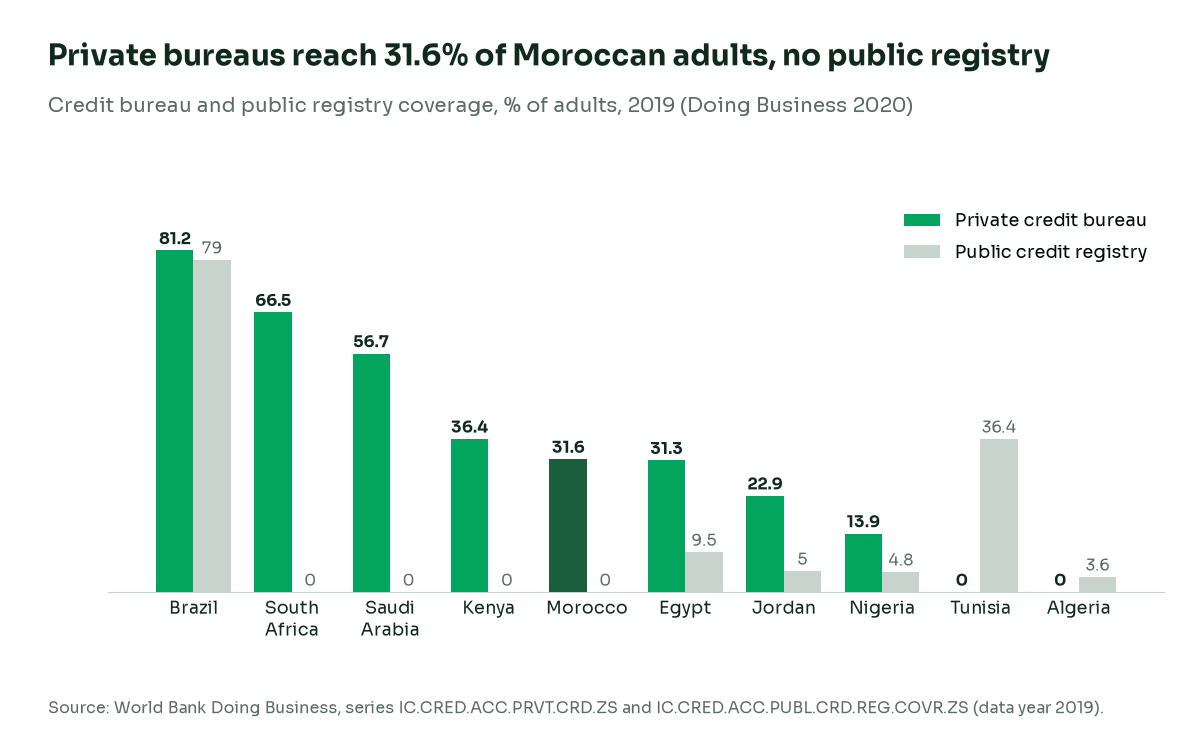
The World Bank's last Doing Business reading puts private credit bureau coverage in Morocco at 31.6% of adults in 2019, up from 9.9% in 2010, with no public registry (World Bank data API). Doing Business was discontinued in 2021, so this is the newest comparable figure I could find.
How does Morocco's credit bureau coverage compare with other countries?
The World Bank's Doing Business 2020 report gives data for 2019 on private credit bureaus and public credit registries, as a share of adults. Morocco had 31.6% for private bureaus and 0% for public registries. Egypt had 31.3% and 9.5%, Jordan 22.9% and 5%, Nigeria 13.9% and 4.8%, Saudi Arabia 56.7% and 0%, Kenya 36.4% and 0%, South Africa 66.5% and 0%, and Brazil 81.2% and 79%. Tunisia reported 0% for private bureaus and 36.4% for its public registry, and Algeria 0% and 3.6%.
The report also scores the depth of credit information from 0 to 8. In 2019 Morocco scored 7, as did Tunisia, South Africa and Senegal. Egypt, Jordan, Saudi Arabia, Kenya, Nigeria and Brazil scored 8, and Algeria 0.
What does Law 01-22 change?
The text is Dahir 1-24-12 of 20 February 2024. It is about credit information bureaus. (It is sometimes confused with Law 31-13 on the right of access to information, which is a different text.) The French version was published in Bulletin Officiel n° 7410 of 5 June 2025. Here is what I read in it, with the article numbers.
| Topic | What the law says | Article |
|---|---|---|
| Supervisor | A bureau must be approved by the Governor of Bank Al-Maghrib, which supervises and controls its activity | 4, 34 |
| Who can be a bureau | A public limited company with registered shares and head office in Morocco | 5 |
| Who provides data | Credit institutions, licensed telecom operators (list set by Bank Al-Maghrib and the telecom regulator ANRT), private bodies running a public service under delegation, other public or private legal entities holding information, other bureaus | 20 |
| Buy now, pay later | Firms offering deferred payment may become providers and users | 26 |
| Use by banks | Credit institutions must consult a bureau for every credit request, rescheduling or restructuring | 28 |
| Consent | Prior consent for any collection, use, sharing or dissemination; specific, free and explicit | 1, 24, 30 |
| Exempt from consent | Public information, and requests from Bank Al-Maghrib, a criminal court or persons legally entitled | 30 |
| Banned data | Balances and transactions of savings and current accounts (except unpaid cheques); sensitive data; opinions on whether to grant a loan | 29, 19 |
| Retention | Not more than five years | 17 |
| Consumer rights | One free solvency report a year, within 5 working days; correction or deletion at no cost; list of who consulted the file | 31, 32, 18 |
| Data abroad | Needs prior CNDP authorisation and an opinion of Bank Al-Maghrib | 23 |
| Entry into force | When the implementing texts are published; banks then have 12 months to adapt | 47, 48 |
Three points matter for thin files.
First, telecom data is included. The 2020 draft, reviewed by the data protection commission in deliberation D-170-2020, listed telephone operators and utilities as possible providers. The final text keeps licensed telecom operators and delegated public-service operators. It does not name water or electricity distributors, and it does not name insurers.
Second, the law does not open account data to bureaus. Article 29 bars balances and transactions of current and savings accounts.
Third, the law is not working yet. Article 47 ties its entry into force to the publication of Bank Al-Maghrib's implementing texts, covering capital, consent notices, complaint handling and more. I found none on the Bank Al-Maghrib site, and the 2025 supervision report does not mention the bureau law.
What does research say about cash-flow data for borrowers with no bureau file?
The studies below use data from the United States and Germany. None uses Moroccan data. I describe only what each source says.
FinRegLab, 2019. The report uses data from six non-bank lenders (Accion, Brigit, Kabbage, LendUp, Oportun and Petal) that use cash-flow variables or scores. Five supplied loan-level data on more than 90,000 originated loans, and the sixth ran an internal analysis of more than 20,000 loans. The analysts compared cash-flow variables and scores with traditional credit scores, and with combined models, using the area under the ROC curve (AUC), where 0.5 is random and 1.0 is perfect. At four of the five lenders the cash-flow-only models had AUCs from .592 to .725. The fifth had .572 and few delinquent loans. Of the four lenders with traditional scores, three had cash-flow-only AUCs at least as high as the traditional ones. At the fourth, cash-flow models scored .675 and .688 against .720 for a traditional score plus other attributes, and a combined model scored .758. The report says the lenders did not supply account records or algorithms, so it tests the variables in general, not their proprietary models, and it could not count thin-file borrowers consistently across lenders.
FinRegLab and NYU Stern, 2025. The fact sheet covers about 38,000 small business loans from two fintech lenders, originated between August 2015 and May 2024. Models with the owner's personal credit score, industry and firm age were compared with models that added about two dozen metrics from bank account data. These were logs of deposits, withdrawals and balances, standard deviations of deposits and balances, ratios between them, and counts of low or negative balance events, insufficient-funds incidents and daily-payment loans. The AUC of a machine learning model rose from .652 to .663, with larger gains for owners with scores under 700 and the largest for low-score owners whose firms were under five years old. The model reclassified 3.6 times as many low-score borrowers as substantially lower risk than as substantially higher risk, and 7.6 times for young firms. Amount and volatility of deposits and balances contributed most, then withdrawals and the number of low or negative balance events.
£171M
CFPB, 2023. In a blog post of 26 July 2023, Bureau researchers looked at three cash-flow proxies. People with accumulated savings of 3,000 dollars or three months of expenses were close to 70% less likely to have a serious delinquency in the following two years. Those who saved regularly without overdrafts were close to 40% less likely, and those who paid bills on time about 20% less. The post notes small samples: fewer than 1,000 respondents had credit scores below 720.
Berg and co-authors, 2020. The working paper studies 270,399 purchases at a German online retailer between October 2015 and December 2016, with goods shipped before payment. Ten digital footprint variables, such as device type, operating system and email provider, gave an AUC of 69.6%, against 68.3% for the credit bureau score. Both together gave 73.6%. In the sample, 15,591 purchases (6%) had no bureau score, and for those customers the digital footprint AUC was 72.2%, against 69.6% for scorable customers (68.8% against 68.3% out of sample).
30%
What guarantees does Tamwilcom offer small firms?
Tamwilcom's home page gives figures to the end of 2025: 54 billion dirhams of financing mobilised, 34 billion of commitments and more than 86,000 operations, about 72% of them for small and medium firms. It also reports more than 20,000 credits guaranteed under Damane Express in the first half of 2026, for 2.7 billion dirhams.
The Damane Express page sets the terms for very small firms. The guarantee covers 75% of the credit, and 80% for firms mostly owned or managed by women. It covers short, medium and long-term bank credits, leases up to 1 million dirhams and honour loans up to 300,000 dirhams. The risk ceiling is 2 million dirhams per firm and per lender. The commission is 0.5% excluding tax for short-term credit and 1.5% flat for medium and long-term credit, with a minimum of 200 dirhams per operation. Requests go through the bank, the leasing company or an approved association, and are processed within 48 hours. All sectors are eligible except real estate development and deep-sea fishing. The very small enterprise page adds Damane Intelak, with a guarantee of up to 80% of the credit for entrepreneurs, self-employed entrepreneurs and young firms, with no commission.
None of these pages says what data the bank uses to score the borrower. Bank Al-Maghrib's 2025 supervision report says banks, microfinance institutions and Tamwilcom are to offer credit and guarantee products adapted to very small enterprises, and that it introduced a refinancing mechanism for them in March 2025.
How big is microfinance in Morocco?
The 2025 supervision report (page 83) counts 10 microfinance associations at the end of 2025, with 1,647 points of sale and 740,000 clients, 48% of them women. Gross microcredit outstanding was 10.6 billion dirhams, up 11.1% after 9.4% a year earlier. The average loan was 14,293 dirhams, against 12,760 dirhams in 2024. The four largest associations distribute more than 98% of the credit. Micro-enterprise takes 89% of loans and social housing 11%, and 86% of loans are in urban areas. Non-performing loans came to 509 million dirhams, a risk rate of 4.8% against 4.7% a year earlier.
How many Moroccans use mobile phones and digital payments?
In 2024, 90.2% of Moroccan adults owned a mobile phone (World Bank Findex data). In the same year 31.99% made or received a digital payment, against 30.30% in 2021 (World Bank data). The survey also reports that 57.6% of adults borrowed any money in 2024 and 57.0% in 2021, and 50.6% of those aged 15 to 24 in 2024 (all adults, ages 15 to 24). The series does not separate formal from informal lenders.
What does Moroccan law say about personal data?
Law 09-08 applies, and the CNDP enforces it. Article 4 makes the person's unequivocal consent the main basis for processing, with exceptions such as performance of a contract or a legal obligation. Financial data is not on the list of sensitive data in article 1. Articles 52 to 55 set fines and prison terms for breaches, and article 64 doubles the fines for legal entities.
I found no CNDP position on credit scoring or open banking. The nearest public opinion is on remote account opening: in deliberation D-108-2020 the CNDP expressed strong reservations about each provider building its own biometric base.
About Sahl
At Sahl we build verification and insights for lenders. The platform page describes what is available, and the developers page shows how teams integrate it. Our security page covers how we handle data. Related: what open banking is and why Morocco is not there yet and KYB: the document checklist for a Moroccan SARL.
This article is general information, not legal advice.
What to do next
- Watch for the Bank Al-Maghrib circulars that put Law 01-22 into effect.
Glossary
- Thin file: a credit record with little or no history.
- Credit bureau: a company that collects repayment data from lenders and sells reports and scores.
- Alternative data: data that shows financial behaviour but does not come from a loan, such as transactions or telecom payments.
- TPE: très petite entreprise, a very small enterprise.
- CNDP: the Moroccan data protection authority.
- ANRT: the national telecom regulator.
- Tamwilcom: the public guarantee company that supports credit to small firms.
- Informal sector: units that are not registered or do not keep formal accounts, as defined in the HCP survey.
FAQ
What does thin file mean in credit scoring?
A thin file is a credit record with little or no history: few or no loans, cards or repayments reported to a credit bureau.
How many Moroccans have a thin file?
I could not find a public figure. What public data does show is that 30.21% of 15 to 24 year olds had an account in 2024 and that private bureau coverage was 31.6% of adults in 2019. Neither is a count of thin files.
What is alternative data in credit scoring?
Data that shows financial behaviour but does not come from a loan, such as telecom payments. In Morocco, Law 01-22 lets licensed telecom operators and some other bodies feed bureaus once it takes effect, but it bars current account transactions.
Do credit bureaus in Morocco use telecom and utility data?
Before Law 01-22 the bureaus drew only on credit institutions, according to a 2019 press article. The law allows licensed telecom operators as providers, with the list set by Bank Al-Maghrib and ANRT, but it takes effect only after the implementing texts, which I did not find.
What does cash-flow data add to a credit score in published studies?
In FinRegLab's 2019 study, cash-flow-only models had AUCs from .592 to .725 at four of five lenders, and at one lender a combined model scored .758 against .720 for traditional data alone. In its 2025 study of about 38,000 small business loans the AUC rose from .652 to .663. Both studies use United States data.
What does a Tamwilcom guarantee cover?
Damane Express guarantees 75% of a bank credit, 80% for firms mostly owned or managed by women, with a risk ceiling of 2 million dirhams per firm and per lender, according to the Tamwilcom page.
Which law governs credit bureaus in Morocco?
Law 01-22, promulgated by Dahir 1-24-12 of 20 February 2024. It sets approval by the Governor of Bank Al-Maghrib, consent rules, a five-year retention limit and consumer rights such as a free yearly report.
Is Law 01-22 the access to information law?
No. Law 01-22 covers credit information bureaus. The right of access to information is Law 31-13.
Sources
All links were opened on 7 October 2026 unless noted. Figures are as of that date.
Morocco, primary
- Law 01-22 on credit information bureaus, Dahir 1-24-12, BO n° 7410 (French, 5 June 2025).
- Law 09-08, articles 1, 4, 52 to 55 and 64.
- CNDP deliberation D-170-2020 and D-108-2020.
- Bank Al-Maghrib, Rapport sur la supervision bancaire 2025.
- HCP, informal sector survey 2023/2024 and HCP, employment results 2025.
Morocco, primary (added)
- Bank Al-Maghrib 2025 report, microfinance (page 83) and the TPE charter (page 144), opened 7 Oct 2026.
- Tamwilcom home page, Damane Express and very small enterprises, opened 7 Oct 2026.
International, primary
- World Bank Global Findex 2025 with the data series linked in the text.
- World Bank Enterprise Surveys, Morocco 2023 and microdata catalogue.
- World Bank Doing Business credit bureau coverage series.
- Experian press release, 2008 and Creditinfo Chronicle, 20 July 2015, both company statements.
- World Bank Doing Business 2020 series: private bureaus, public registries and depth of credit information, opened 7 Oct 2026.
- FinRegLab, The Use of Cash-Flow Data in Underwriting Credit, July 2019 and FinRegLab and NYU Stern, Sharpening the Focus, fact sheet of 3 June 2025, opened 7 Oct 2026.
- CFPB blog, 26 July 2023, read through a page-fetch tool on 7 Oct 2026, and Berg, Burg, Gombovic and Puri, FDIC working paper 2018-04, opened 7 Oct 2026.
- World Bank Findex data for Morocco: mobile phone ownership and borrowing, opened 7 Oct 2026.
Secondary
- FNH, 4 November 2019, used only for how bureaus worked before the new law.
- credit scoring
- thin file
- credit bureau
- Morocco
- cash-flow underwriting